
English 


Views: 8 Author: Tongda Publish Time: 2026-11-06 Origin: Site


JT/T 740‑2024 Hot‑Poured Sealants for Pavement officially took effect on March 1, 2025, replacing the old JT/T 740‑2015 Hot‑Poured Joint Sealants for Pavement. The name was revised from “joint sealant” to “crack sealant”, which more accurately defines the material function.
Five grades are available based on the minimum applicable temperature: Type I (≥0℃) to Type V (≥‑40℃), covering all climate zones across China. Core evaluation indicators include cone penetration, compression rebound recovery rate, viscosity at 190℃, density, and performance after thermal aging (softening point + low‑temperature elongation).
Major updates: The 2024 version removes the “flow value” indicator from the old standard and adds viscosity, density and post‑thermal‑aging performance, which better match real construction conditions.
Selection principle: Choose the grade according to the record extreme minimum temperature at the project site; also control heating temperature to avoid damaging material properties.
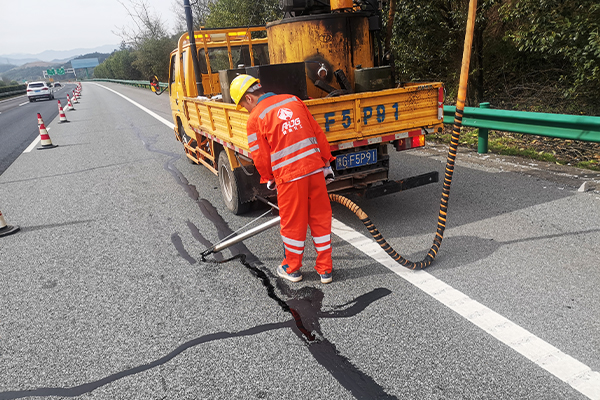
JT/T 740‑2024 Hot‑Poured Sealants for Pavement was drafted under the lead of Research Institute of Highway Ministry of Transport, with participation from Xinxiang Tongda Highway New Technology Co., Ltd. and other industry manufacturers. Released in 2024, it became enforceable on March 1, 2025, serving as a key technical specification for pavement crack repair materials in China.
Change Category | Specific Content |
|---|---|
Term Deletion | Deleted four terms: "sealant", "safe heating temperature", "pouring temperature", "flow value" |
Term Revision | "Hot-poured joint sealant" revised to "hot-poured sealants for pavement"; "elastic recovery rate" revised to "compression rebound recovery rate" |
Indicator Deletion | Removed softening point and low-temperature elongation as independent technical indicators (moved into "performance after thermal aging") |
Indicator Addition | Added four indicators: viscosity (190℃), density, post-aging softening point, post-aging low-temperature elongation |
Besides structural and editorial adjustments, the main technical updates are listed below. Definition: Hot‑poured sealants for pavement are asphalt‑based materials mainly composed of asphalt, rubber powder and polymer modifiers. They are heated for crack repair on asphalt pavements and joint filling on concrete pavements. (JT/T 740‑2024 Clause 3.1)
Crack sealants are divided into five temperature‑based grades for different climate regions.
Grade | Name | Minimum Applicable Temperature |
|---|---|---|
Type I | High-temperature grade | ≥0℃ |
Type II | Normal grade | ≥-10℃ |
Type III | Low-temperature grade | ≥-20℃ |
Type IV | Cold climate grade | ≥-30℃ |
Type V | Severe cold grade | ≥-40℃ |
Definition: The depth that a standard cone vertically penetrates into the sealant specimen under specified test conditions, measured in 0.1 mm. (JT/T 740‑2024 Clause 3.2) Cone penetration reflects material hardness.
Higher values mean softer material. Requirements differ greatly among grades.
Type | Penetration Requirement (25℃, 5s, 150g) (0.1mm) |
|---|---|
Type I | ≤70 |
Type II | 50~90 |
Type III | 70~110 |
Type IV | 90~150 |
Type V | 120~180 |
Selection tip: Cold regions require higher cone penetration grades such as Type V (120~180) to keep the material flexible at low temperatures and prevent brittle cracking.
Definition: The percentage of recoverable compressive deformation of the sealant specimen under specified test conditions. (JT/T 740‑2024 Clause 3.3) This indicator replaces the former elastic recovery rate. All grades must meet 30%–70%. It shows how well the material rebounds after compression, which decides long‑term sealing performance under repeated vehicle loads.
Viscosity is a new core indicator in the 2024 version, with a required range of 1–4 Pa·s. It directly controls pumpability and pourability. Too high viscosity restricts penetration into deep cracks; too low viscosity causes flowing and sagging.
Density requirements decrease progressively across the five grades.
Grade | Density Requirement (g/cm³) |
|---|---|
Type I | ≤1.50 |
Type II | ≤1.45 |
Type III | ≤1.40 |
Type IV | ≤1.35 |
Type V | ≤1.30 |
A major upgrade in this standard. Softening point and low‑temperature elongation are combined into one post‑thermal‑aging test after aging at 190℃, simulating real heating and construction conditions.
Grade | Softening Point after Thermal Aging (℃) | Low-Temperature Elongation Requirement |
|---|---|---|
Type I | ≥90 | 0℃, 50%, 3 cycles, pass |
Type II | ≥80 | -10℃, 75%, 3 cycles, pass |
Type III | ≥80 | -20℃, 100%, 3 cycles, pass |
Type IV | ≥80 | -30℃, 150%, 3 cycles, pass |
Type V | ≥70 | -40℃, 200%, 3 cycles, pass |
Note: 50%, 75%, 100%, 150%, 200% refer to the ratio of elongation at the specified temperature to the specimen thickness of 15 mm.
Comparison Item | JT/T 740-2015 | JT/T 740-2024 |
|---|---|---|
Standard Name | Hot-poured joint sealant for pavement | Hot-poured crack sealant for pavement |
Core Indicators | Softening point, low-temperature elongation, flow value, elastic recovery rate | Cone penetration, compression rebound recovery rate, viscosity, density, performance after thermal aging |
Aging Evaluation | No thermal aging simulation | New test after thermal aging at 190℃ |
Construction Guidance | No viscosity parameter | Viscosity index added to guide heating temperature control |
According to field research published in China & Foreign Highway, heating temperature strongly affects sealant performance:
After 12 h aging at 160℃: viscosity increases by approx. 17.1%
After 12 h aging at 220℃: viscosity increases by approx. 157.7%
For construction within 3 hours: 200℃ is the preferred heating temperature
For construction lasting over 9 hours: 180℃ is recommended
Conclusion: Contractors must strictly control heating temperature and holding time. Long‑term high‑temperature heating will harden the sealant.
Follow this workflow when selecting crack sealants:
Confirm climate zone: Select grade based on the local extreme minimum temperature
Verify key indicators: Focus on cone penetration, low‑temperature elongation and post‑aging softening point
Check construction parameters: Set heating temperature according to viscosity
Confirm compliance: Test reports must satisfy JT/T 740‑2024
You may refer to products from standard drafting participants. As one of the drafters of JT/T 740‑2024, Xinxiang Tongda Highway New Technology Co., Ltd. supplies the Tongda series hot‑poured crack sealants covering Type I to Type V, with complete test reports for your evaluation.